Why AI Chatbots Make Things Up (and What Actually Helps)
Posted on Sun 20 September 2026 in AI Explained
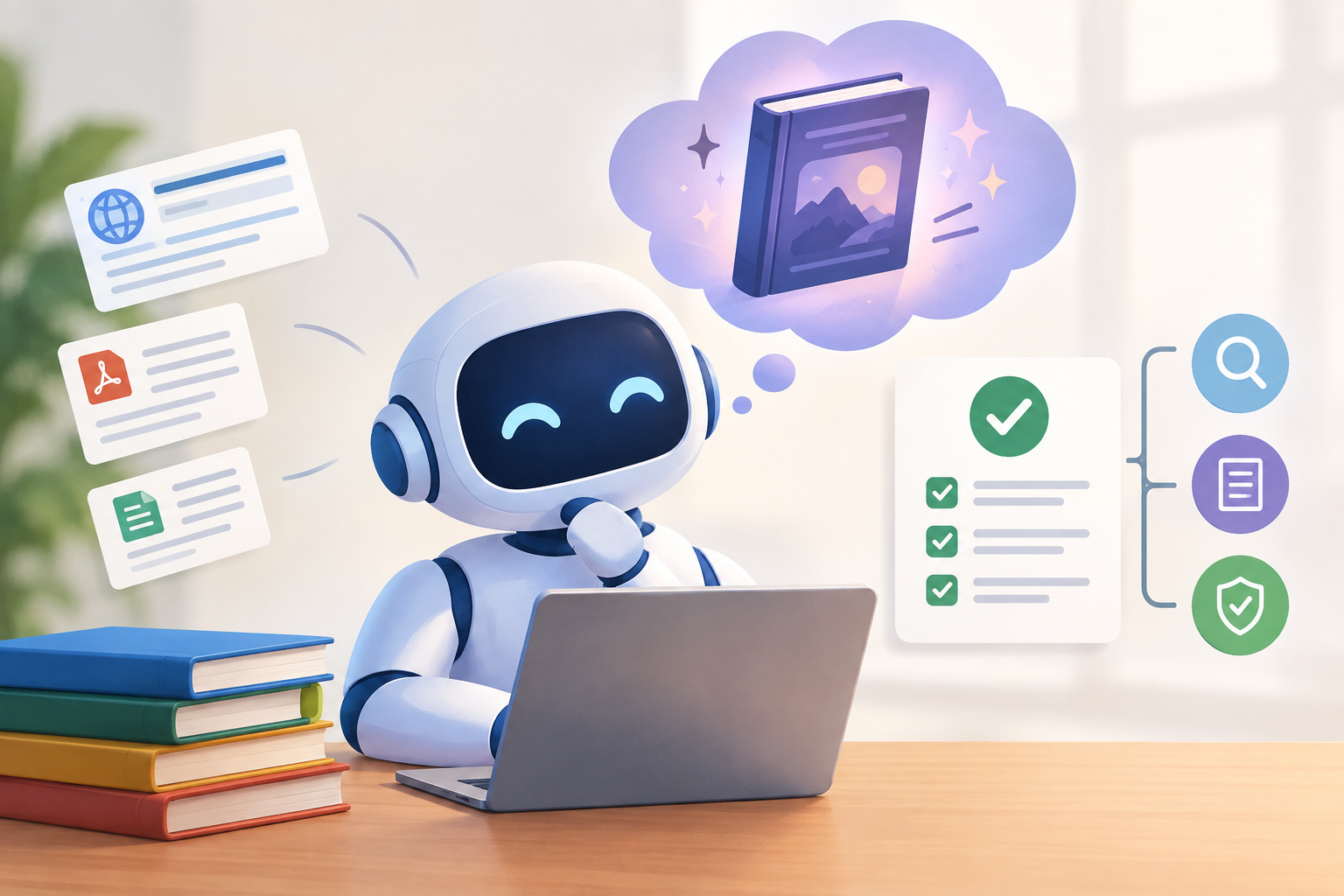
You ask a chatbot for a book recommendation. It gives you a title, an author, even a publication year. The book doesn't exist.
This is called hallucination, and it isn't a glitch that engineers forgot to fix. It comes from how these systems are built and trained. Once you see why, you can work around it.
A chatbot is not looking facts up. It predicts what a good answer would sound like, one word at a time. Usually sounding right and being right go together, but sometimes they don't, and the chatbot can't always tell the difference.
The Real Causes
Trained to Sound Right — During training, the model read enormous amounts of text and got very good at continuing it naturally. Fluent, confident writing was the skill being built, and truth is a side effect of that skill rather than the goal.
Guessing Gets Rewarded — Picture an exam where a wrong answer costs nothing but a blank costs a mark. You would guess every time. Researchers have argued that many training and testing setups work this way, so models learn to answer confidently instead of admitting uncertainty.
Unpredictable Facts — A model can learn that capitals belong to countries because that pattern repeats millions of times. A birthday, an obscure court case, or a paper's page numbers follow no pattern, so a fact seen only once or twice in training leaves just a faint trace.
Blurry Memory — Everything the model learned is squeezed into a fixed set of numbers, not stored like files in a cabinet. Like a heavily compressed photo, the big shapes survive and the fine details smudge, and names, dates, numbers, and quotes are fine details.
No Reliable Alarm — You know when you are bluffing, but a model often has no dependable signal that says it is on thin ice. A shaky guess and a solid fact can come out in exactly the same confident voice.
Snowballing Errors — Every word the model writes becomes context for the next one. If it invents a detail early on, it tends to keep the story consistent with that invention instead of backing out.
Pushy Questions — Leading questions ("Why did Einstein fail math?"), false assumptions, and requests like "give me five sources" nudge the model to produce something. When nothing real exists, it fills the gap with something plausible.
What Actually Helps
Give It the Source — Paste in the document, or use a tool with web search or file access, and ask it to answer from that material. This is the biggest single improvement, because it turns a memory test into an open-book test.
Allow "I Don't Know" — Add a line like "If you're not sure, say so." It works best when paired with source material, since the model then has something concrete to check against.
Ask for Evidence — Request a quote or the exact location that supports each claim. Unsupported statements become much easier to spot when the model has to point at something.
Ask Twice — Put the same question in different words and compare. If the answers disagree on a detail, treat that detail as suspect.
Verify the Risky Parts — Names, numbers, dates, quotes, citations, and legal or medical claims are where invention hides. Check these yourself before relying on them.
Play to Its Strengths — Drafting, summarizing text you provide, brainstorming, and explaining well-known concepts are far safer uses. Recalling obscure specifics from memory is where it fails most often.
What Doesn't Help (As Much As You'd Think)
"Don't Hallucinate" — The model has no switch for this. Adding it to a prompt may help slightly at the margins, but it is not a fix.
"Are You Sure?" — The model often doubles down or flips to a different answer. Neither response reflects real checking, so the question tells you little.
Lower Randomness — Turning the randomness setting down makes answers more repeatable, not more accurate. A consistent wrong answer is still wrong.
Confident Detail — Specifics like a page number or a quote feel credible, but they are exactly what gets fabricated. A detailed answer is not evidence of a correct one.
Trusting Citations — Made-up references can look perfectly formatted, with plausible authors and journals. Always click through before you rely on one.
Assuming Newer Means Immune — Bigger and newer models are generally better, but no current model has eliminated the problem. Keep verifying, whatever the version.
The Takeaway
Treat a chatbot like a very well-read colleague who never wants to disappoint you. It is fast, articulate, and often right, but it will sometimes fill a gap with something plausible. Give it real material to work from, let it admit uncertainty, and verify anything you would be embarrassed to get wrong.