What LangSmith Is and Why LLM Apps Need Observability
Posted on Sat 19 September 2026 in LLM Engineering
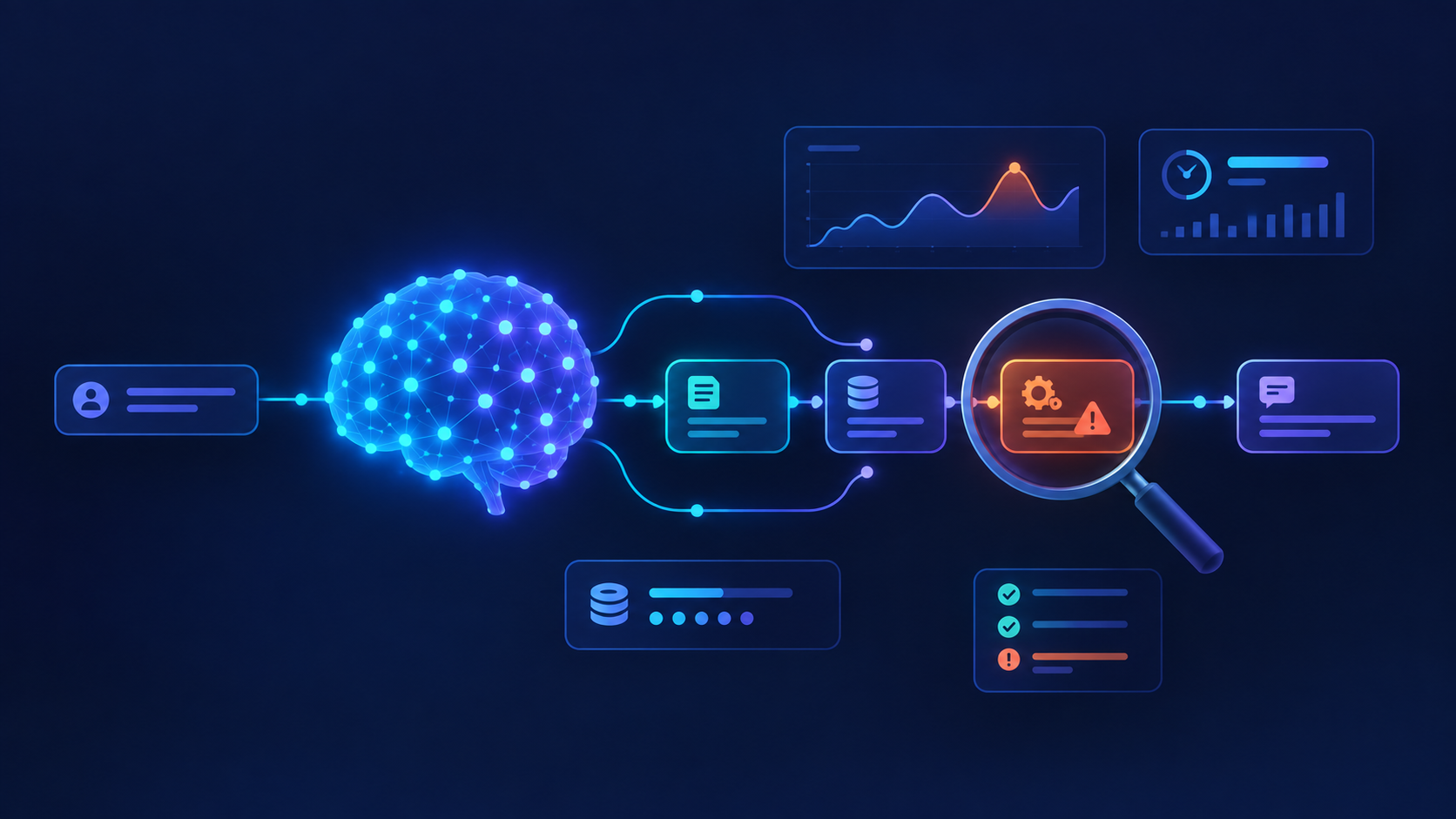
Shipping an LLM app is the easy part. Knowing why it gave a wrong answer at 2 a.m. on a Tuesday is the hard part. Traditional software fails loudly with a stack trace. LLM apps fail quietly: the code runs, the API returns 200, and the answer is confidently wrong. LangSmith is a platform built to make those silent failures visible.
Why Normal Logging Falls Short
A typical LLM app is not one function call. It is a chain of steps: a prompt gets assembled, documents get retrieved, a model gets called, a tool gets invoked, and the result feeds another model call. Print statements and standard application logs were never designed to capture that shape.
Non-Deterministic Output — The same input can produce different outputs on different runs. A bug you saw once may not reproduce, so you need the exact prompt, model settings, and response saved from the moment it happened.
Hidden Intermediate Steps — The final answer is only the last link in a long chain. A bad answer is often caused by a bad retrieval or a malformed tool call several steps earlier, and you cannot see that from the output alone.
Cost and Latency Drift — Token usage and response time change as prompts, models, and traffic change. Without per-step measurement, a small prompt edit can quietly double your bill.
Quality Is Not a Boolean — There is no exception to catch when an answer is merely mediocre. You need a way to score outputs, not just detect crashes.
What LangSmith Is
LangSmith is an observability, evaluation, and prompt-management platform for LLM applications, built by the team behind LangChain. Despite the association, it is not limited to LangChain. You can trace apps built with LangGraph, the OpenAI or Anthropic SDKs, or plain Python and TypeScript by wrapping your functions with the traceable decorator or its equivalent. In many setups, turning tracing on is a matter of setting a couple of environment variables such as your API key and a tracing flag.
The Core Building Blocks
Trace — The full record of one request moving through your app. It captures every step in order, with inputs, outputs, timing, token counts, and errors, so you can replay exactly what happened.
Run — A single step inside a trace, such as one model call, one retrieval, or one tool call. Runs are nested, which lets you drill from a slow or wrong final answer down to the exact step responsible.
Project — A container that groups traces from one app or environment. Separating development, staging, and production keeps your debugging data from mixing with real user traffic.
Dataset — A saved set of example inputs, and optionally reference outputs, used for testing. The most useful datasets are built from real production traces where the app struggled.
Evaluator — A function or LLM-as-judge that scores an output against criteria you care about. It can check correctness, groundedness, tone, or format, and it turns "this feels worse" into a number you can compare across versions.
Annotation Queue — A workflow that routes traces to humans for review and labeling. Human judgments give you trustworthy ground truth and help you calibrate any automated judge.
The Loop That Makes It Useful
The real value is not any single feature. It is the feedback loop between them. You trace production traffic, find failures, save them into a dataset, change a prompt or a model, and rerun the evaluators on that dataset before you ship. Each cycle makes the next regression less likely. Without that loop, every prompt change is a guess.
Observability Is Not Optional
It is tempting to treat observability as something to add after launch. With LLM apps that is backwards. The moment real users touch your system, you are exposed to inputs you never imagined, and the only way to learn from them is to have recorded what happened. Tracing from day one costs little. Reconstructing a failure you never logged costs a lot.
Takeaway
LLM apps break in ways that logs and unit tests alone cannot catch. LangSmith gives you traces to see what happened, datasets and evaluators to measure quality, and a workflow to improve it over time. If you are running an LLM app in production, or about to, start by turning on tracing and reading a few real traces. You will learn more from ten of them than from any amount of guessing.