What Is an FQDN? Breaking Down Your Azure Container Apps URL
Posted on Sat 12 September 2026 in Cloud & Infrastructure
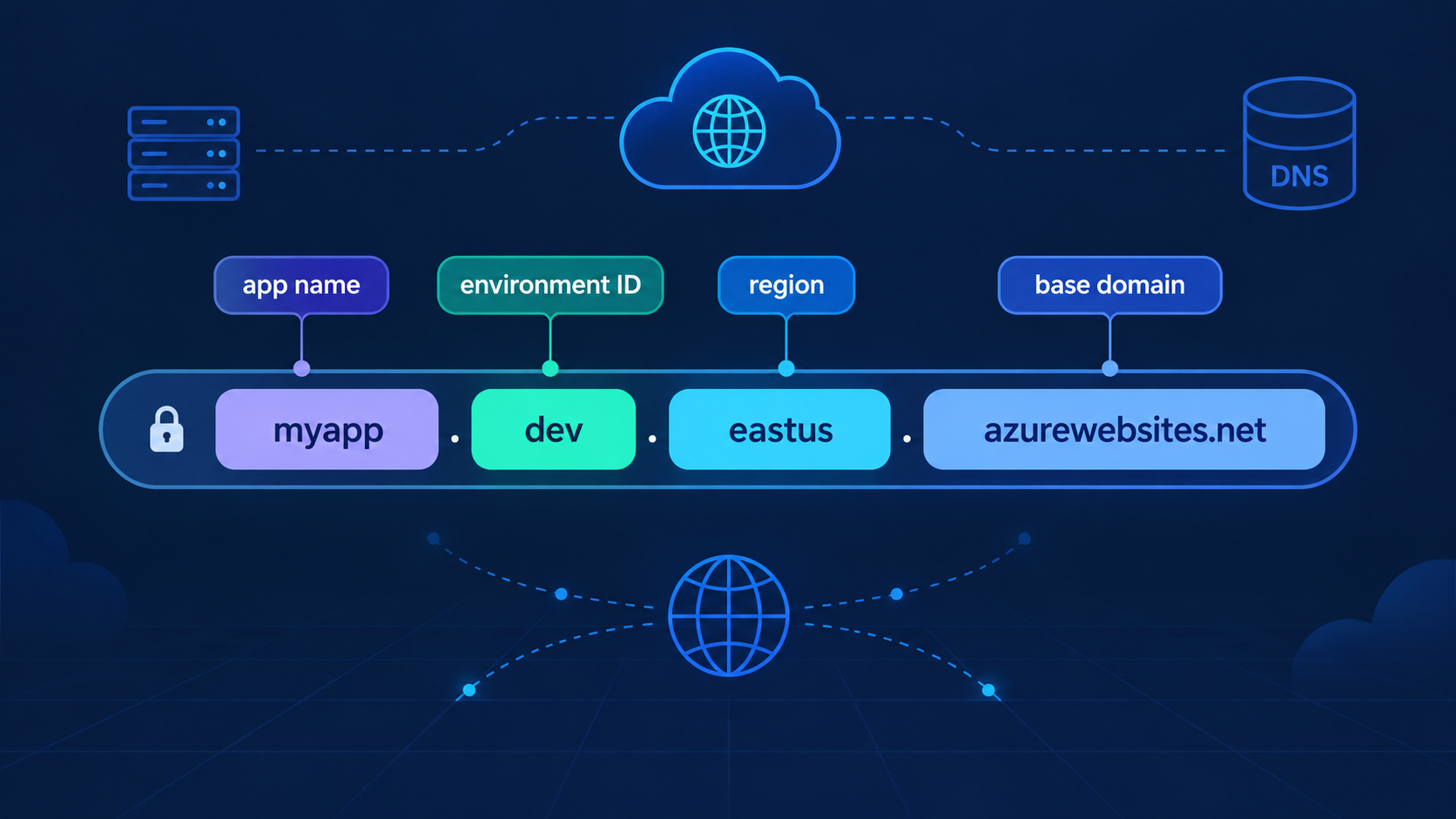
FQDN stands for Fully Qualified Domain Name. It's the complete, unambiguous address of a host on the internet — every level of the domain hierarchy spelled out, right up to the top-level domain. When you deploy something to the cloud and get back a long, auto-generated URL, that URL is an FQDN, and understanding its pieces makes debugging, DNS setup, and custom domains far less mysterious.
Why "Fully Qualified" Matters
A regular hostname on its own — say, myfastapi — is ambiguous. It could exist on your local network, inside a private VPN, or as a container app in Azure. It only becomes fully qualified once every level of the DNS hierarchy is attached to it, with nothing left to infer. A browser, a load balancer, or a DNS resolver anywhere in the world can take a true FQDN and resolve it to exactly one place.
That's the practical value of the term: an FQDN is portable and unambiguous. Anyone, anywhere, using any resolver, arrives at the same destination.
Anatomy of an Azure Container Apps FQDN
Take an example FQDN like this:
myfastapi.wittyhill-1a2b3c4d.canadacentral.azurecontainerapps.io
Each segment tells you something specific:
App Name (Subdomain)
myfastapi is the name you gave your application when you deployed it. This is the leftmost label in the FQDN and the part you have the most control over — it's typically set at deploy time and used to distinguish your app from every other container app in the same environment.
Environment Identifier
wittyhill-1a2b3c4d is a unique identifier Azure generates for your Container Apps environment. This isn't something you choose; Azure creates it to guarantee that environments never collide, even if two different subscriptions both have an app called myfastapi.
Region
canadacentral tells you where the underlying infrastructure physically lives — in this case, Azure's Canada Central region. This segment matters for latency, data residency requirements, and matching the region of other resources your app talks to.
Base Domain
azurecontainerapps.io is the root domain Microsoft controls for all Container Apps deployments. It's the top-level anchor that every Container Apps FQDN shares, similar to how every GitHub Pages site shares github.io.
Putting It Together
Stack those four pieces and you get a single, globally unique address. Prefix it with https:// and that's the exact string you'd paste into a browser to reach your deployed app — no guessing, no local DNS tricks, no ambiguity about which environment or region it points to.
Why This Design Makes Sense
Auto-generated FQDNs like this one solve a real problem: uniqueness at scale. If Azure let every user simply claim myfastapi.azurecontainerapps.io, name collisions would be constant. By inserting a randomly generated environment identifier and a region into the hostname, Azure guarantees your app gets a globally unique address without you having to negotiate a name with anyone else.
This is also why, once you're ready to go to production, most teams map a custom domain (like api.yourcompany.com) on top of the generated FQDN with a CNAME record — you get a clean, brandable name for humans while the underlying FQDN keeps doing the unambiguous routing work underneath.