HelixDB: One Database for Graphs, Vectors, and AI Memory
Posted on Wed 07 October 2026 in Databases
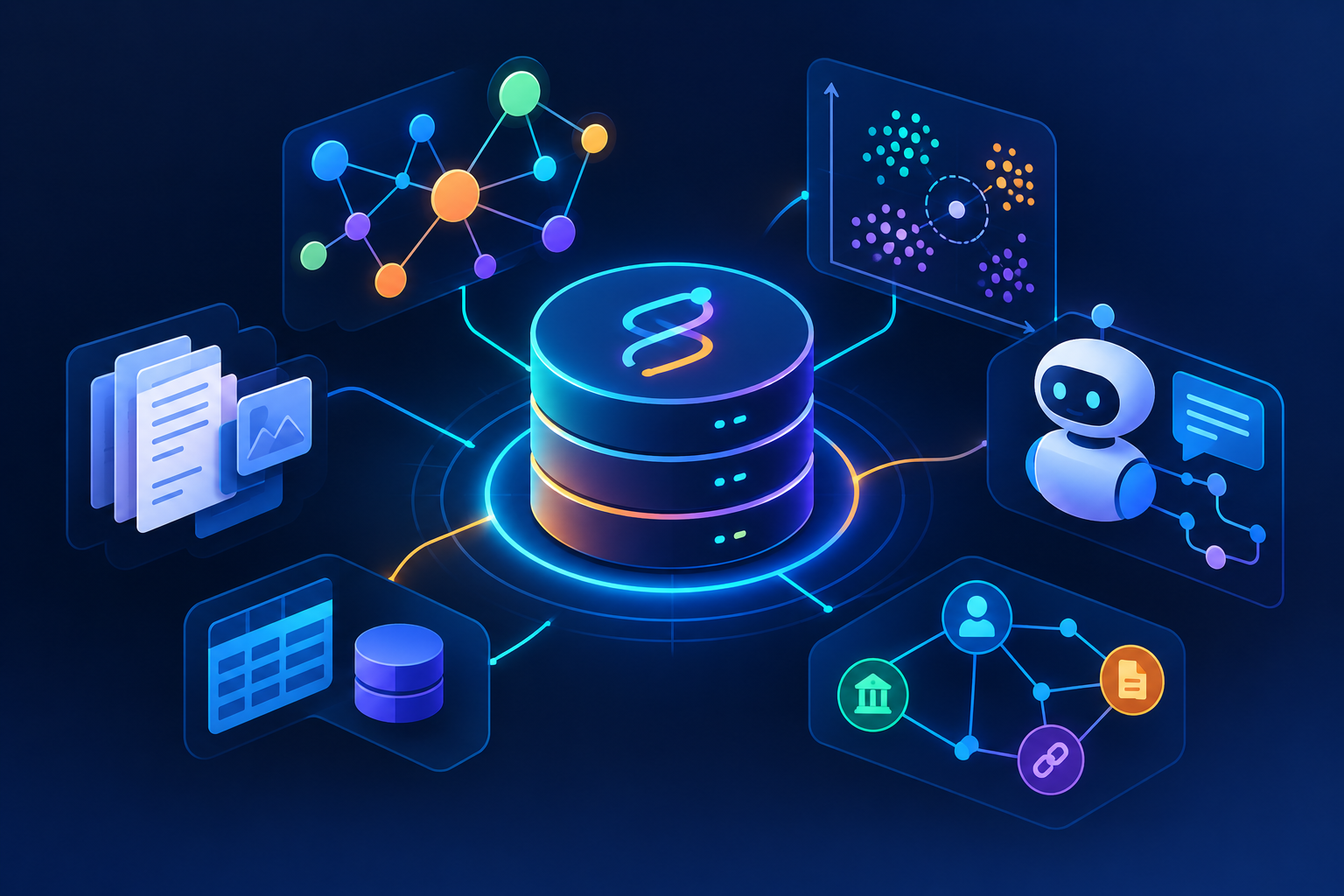
Building an AI application usually means stitching together half a dozen systems: a relational database for app state, a vector store for embeddings, a graph database for relationships, and glue code to keep them in sync. HelixDB is an open-source database that tries to collapse that stack into one engine. It is written from scratch in Rust and built for RAG pipelines, agents, and knowledge graphs.
What It Is
Graph-Vector Database — HelixDB is an OLTP database whose primary abstraction is graph + vector. Nodes, edges, and embeddings live in the same engine, so you don't run a graph DB next to a vector DB and sync them.
Beyond Graph and Vector — It can also support key-value, document, and relational access patterns. The goal is to give an agent or RAG pipeline a single place to store everything it needs.
The Data Model
Property Graph Foundation — HelixDB follows the property graph model: nodes, edges, properties, and labels. Edges are directional and can carry properties of their own.
Vectors as First-Class Citizens — Vectors are entities with their own identifiers and embeddings. Edges can connect nodes and/or vectors, so you can relate a document chunk to the entities it mentions without leaving the database.
Querying with HelixQL
A Typed, Compiled Language — HelixDB has its own query language, HelixQL, which is strongly typed and compiled. Queries are checked before they run, and the CLI includes a helix check command for validating them.
Traversal and Search in One Chain — A single query can walk graph edges and then run a nearest-neighbor vector search. The docs also list multi-hop traversals, keyword/BM25 search, and reranking. For RAG this means retrieval that mixes semantic similarity with explicit relationships.
SDKs — Official SDKs exist for Python, TypeScript, Rust, and Go. The TypeScript client talks to a local instance on port 6969 by default.
Built for Agents
Built-in MCP Tools — HelixDB ships with MCP support, so an agent can discover the data and walk the graph itself instead of generating human-readable queries. That removes a common failure point in agent-to-database workflows.
Private by Default — The project describes itself as secure by default, with instances private unless you expose them.
Getting Started
Local Workflow — You install the CLI with an install script, then run helix init to scaffold a project and helix deploy --local to start an instance. The helix instances, helix start, and helix stop commands manage what is running.
When It Fits (and When It Doesn't)
Good Fit — Applications that need graph traversal and vector similarity together: RAG with entity relationships, agent memory, knowledge graphs, and recommendation systems that combine user-item graphs with embeddings.
Poor Fit — If your app needs neither vector search nor graph traversal, the hybrid model is unnecessary overhead. A plain relational or key-value store will be simpler and cheaper.
Alternatives — Neo4j is the more mature graph database, with vector support added later. Postgres with pgvector is the familiar choice if you want to stay on a conventional RDBMS.
Things to Check Before Adopting
Licence — Sources disagree. Older pages say AGPL, while a recent write-up says Apache License 2.0. Read the LICENSE file in the repo (github.com/HelixDB/helix-db) before building on it commercially.
Storage Engine — Earlier descriptions say it runs on LMDB, with an in-house engine planned as a replacement. A recent write-up says it is backed by object storage. The architecture has evidently changed, so confirm what the current release uses.
Maturity — It is a young project with a short release history, so expect the API and internals to keep changing.
Takeaway
HelixDB's pitch is simple: if your AI backend needs both relationships and embeddings, store them together and query them in one pass. Whether it beats a mature graph database or Postgres with pgvector depends on your workload, but a graph-plus-vector design with agent tooling built in is worth a prototype.